

Internet Protocol Television, commonly called IPTV, delivers television and video content through an internet connection rather than traditional terrestrial broadcasting, satellite signals, or conventional cable infrastructure. As streaming technology has developed, providers have introduced platforms designed to manage large libraries, subscribers, devices, and streaming services from a single interface. 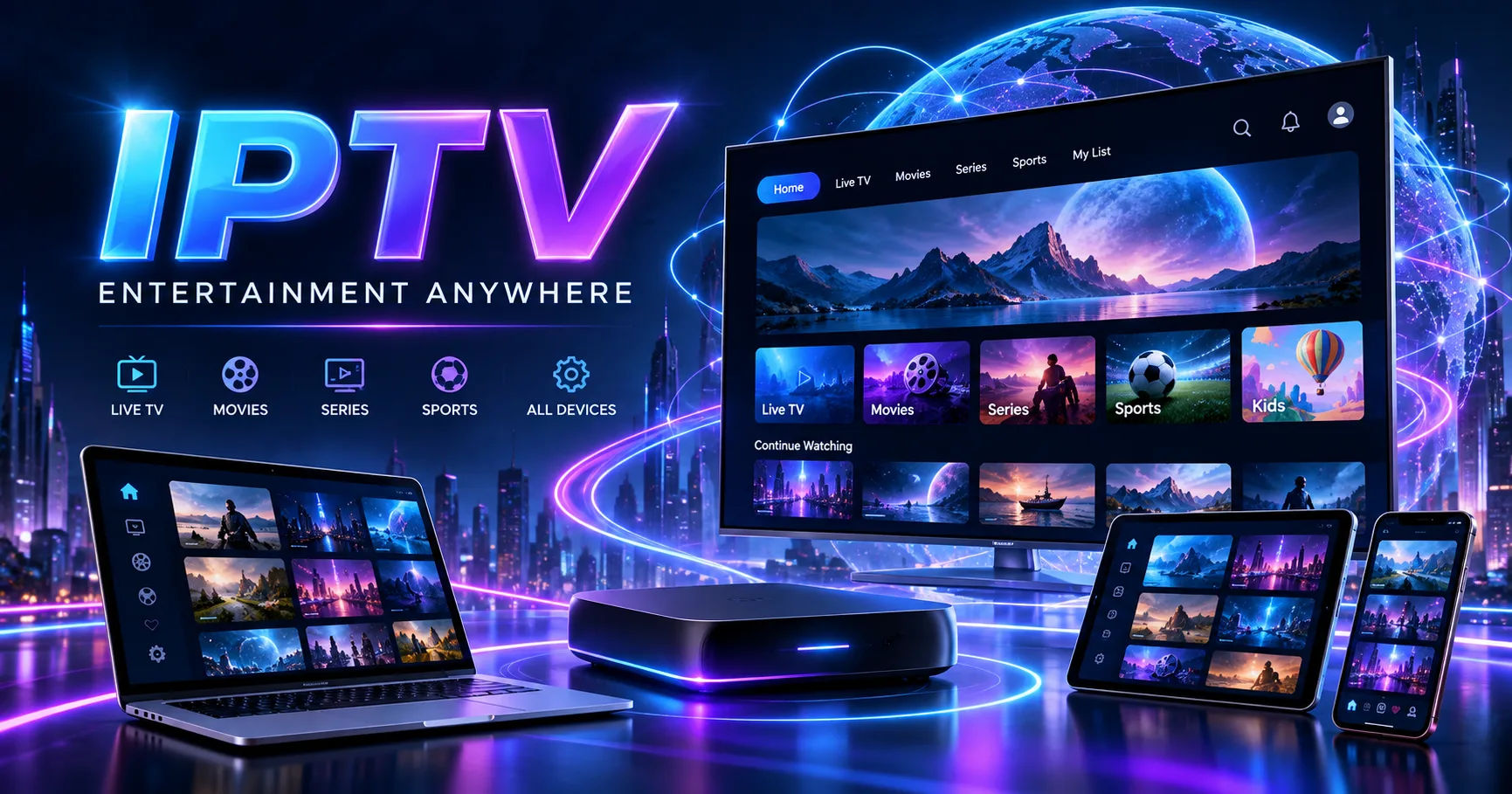 An 8K IPTV reseller panel is generally a management platform used by an IPTV reseller to administer customer accounts and services. The term "8K" usually refers to the claimed ability of a service or provider to offer content in very high resolutions, while "reseller panel" describes the administrative system used to manage subscriptions and users.
It is important to understand that these are two related but different concepts. A panel does not automatically make ordinary video 8K. Resolution depends on the original content, encoding, available bandwidth, streaming infrastructure, and the customer's playback equipment.
For someone exploring IPTV as a business or simply trying to understand how these platforms work, the 8K IPTV reseller panel is essentially the control center between the service provider and the reseller's customers. It can provide tools for creating accounts, managing subscriptions, monitoring usage, and organizing available services.
What Does an IPTV Reseller Panel Do?
An IPTV reseller panel is primarily an administrative tool. Instead of manually managing every customer through separate spreadsheets, messages, or payment records, a reseller can use a centralized dashboard.
The exact features vary from one provider to another, but most panels are designed around customer management.
A reseller might use the dashboard to create a customer account, assign a subscription period, manage device access, renew an existing account, or deactivate a subscription that has expired.
The panel may also display information about active and inactive users. This gives the reseller a clearer picture of how many customers are currently using the service.
Some platforms include additional reporting tools. These may show account activity, subscription expiration dates, connection information, or other operational statistics.
The important point is that the panel is not normally the television service itself. It is the management layer used to administer accounts and access to whatever legally licensed streaming service the provider operates.
Why Is 8K Mentioned?
The term 8K refers to an extremely high video resolution. In consumer video, 8K commonly means approximately 7,680 pixels horizontally by 4,320 pixels vertically.
That is four times the number of pixels found in 4K UHD and sixteen times the number found in 1080p Full HD.
However, seeing "8K" in the name of an IPTV service or reseller panel does not necessarily mean that every channel or program is actually delivered in native 8K.
This distinction matters.
A streaming platform can advertise support for 8K playback while its actual content library contains a mixture of resolutions. Some content could be available in 8K, some in 4K, some in 1080p, and some at lower resolutions.
The quality ultimately depends on the source material.
If a program was originally produced in 1080p, simply displaying it through an 8K IPTV reseller panel does not turn it into genuine native 8K footage. An 8K television may upscale the image, but upscaling and native 8K production are not the same thing.
How an 8K IPTV Reseller Panel Works
The basic process involves several different components.
First, a legitimate IPTV provider operates the underlying streaming infrastructure and obtains the appropriate rights to distribute its content. The provider maintains servers, media systems, authentication services, and other technical components.
The reseller receives access to an administrative panel.
Through that panel, the reseller can generally manage the customer accounts allocated to them by the provider. Depending on the platform, the reseller may create subscriptions, assign service packages, monitor account status, and handle renewals.
The customer then uses a compatible IPTV application or supported device to access the service.
When the customer requests a video stream, the system verifies their account and provides access according to the subscription and permissions assigned to that account.
The panel therefore sits mainly on the management side of the operation. It is not necessarily responsible for encoding every video or physically storing every piece of content.
Main Features You May Find
Customer Account Management
Customer management is one of the central functions of a reseller panel.
A reseller may be able to create new accounts, modify existing accounts, suspend access, extend subscription periods, and view account status.
A well-organized dashboard makes it easier to identify which subscriptions are active and which ones are approaching expiration.
This becomes increasingly important as the number of customers grows.
Managing five customers manually is very different from managing hundreds or thousands.
Subscription Management
Subscription tools allow resellers to keep track of service periods.
For example, a provider might offer monthly, quarterly, six-month, or annual subscriptions. The reseller can assign the appropriate period to a customer and monitor when renewal is required.
Some panels automatically calculate expiration dates.
Others may provide notifications or filtering options that allow the reseller to find accounts approaching expiration.
Device and Connection Controls
Depending on the provider, the panel may allow certain restrictions to be placed on accounts.
For example, a subscription might permit one connection at a time, while another package might permit multiple authorized devices.
These controls help providers manage infrastructure and reduce unauthorized account sharing.
The exact limits should always be clearly explained before purchasing a service.
Service Organization
A large streaming library can become difficult to manage without categorization.
Panels may organize services into categories such as live television, movies, series, sports, documentaries, or other legally distributed programming.
The structure can vary considerably between providers.
Good organization makes the customer-facing service easier to navigate, although the quality of the panel itself does not determine the quality or legality of the content.
Usage Monitoring
Some reseller panels provide basic usage information.
Depending on the system, this could include active sessions, account status, connection information, or bandwidth-related statistics.
Monitoring can help identify technical problems.
For example, if many legitimate customers suddenly experience buffering, operational statistics can help a provider determine whether the issue is related to server capacity, network performance, or another infrastructure problem.
Expiration Tracking
Subscription expiration is particularly important for resellers.
A dashboard can make it easier to identify customers whose subscriptions are ending soon.
Instead of searching through separate records, the reseller can often filter accounts by expiration date.
This improves administrative organization and reduces the possibility of forgetting important account information.
What Does an 8K IPTV Reseller Actually Resell?
The reseller normally does not create television programming themselves.
Instead, they operate as an intermediary for a service supplied by an IPTV provider.
The provider determines what content and technical services are available. The reseller then manages the customers assigned to them.
This arrangement can resemble other digital subscription businesses where one company provides the underlying infrastructure and another party handles customer acquisition or account administration.
The exact commercial relationship depends on the provider's terms.
A reseller should understand what they are actually authorized to sell rather than assuming that access to a panel automatically grants permission to distribute every channel, movie, sports broadcast, or television program shown through it.
Legal and Licensing Considerations
This is one of the most important areas to understand.
IPTV technology itself is not inherently illegal. Internet-based television delivery is a legitimate technology used by many established broadcasters and streaming companies.
The legal question is generally about the content being distributed and whether the distributor has the necessary rights.
A reseller should therefore verify that the provider has authorization to distribute the programming being offered.
A low price, enormous channel list, or claim of access to premium programming does not establish that the service is properly licensed.
Before operating an IPTV reseller business, it is sensible to understand the applicable copyright, broadcasting, consumer-protection, and commercial regulations in the relevant jurisdiction.
The panel is simply software. It does not provide legal permission to distribute copyrighted material.
Internet Requirements for High-Resolution IPTV
High-resolution streaming requires substantial network capacity.
8K video can require considerably more bandwidth than lower-resolution streaming, although the actual requirement depends on compression technology, bitrate, frame rate, codec, and other technical factors.
This means that having an 8K-capable television does not guarantee a smooth 8K streaming experience.
The internet connection needs sufficient speed and stability.
Network congestion can also affect performance. A household might have a fast internet package but still experience buffering if the local wireless network is overloaded or the streaming infrastructure has problems.
For demanding video, a wired Ethernet connection can sometimes provide more consistent performance than a congested wireless connection.
Does Faster Internet Always Mean Better Quality?
Not necessarily.
Internet speed is only one factor.
The source bitrate matters. The encoding quality matters. The streaming server matters. The device matters. The application matters. Network latency and congestion can matter as well.
Imagine two streams using the same internet connection. One is professionally encoded with a stable bitrate and efficient compression, while the other uses poor encoding and inconsistent delivery.
The first stream can look noticeably better even though both technically have enough bandwidth.
This is why claims about "8K quality" should be evaluated carefully rather than based solely on a number printed in a service description.
Devices That May Support High-Resolution IPTV
The device used for playback is another important part of the equation.
Depending on the service and application, IPTV may be accessed through smart televisions, streaming boxes, computers, smartphones, tablets, or other compatible hardware.
However, support for IPTV applications does not automatically mean that a device can decode every available 8K format.
For genuine 8K playback, the entire chain needs to support the required resolution and technical standards.
That includes the source, encoding, application, device, display, and connection between those components.
An older television might display the stream through upscaling, but that is different from native 8K playback.
How Resellers Should Evaluate a Panel
A reseller should look beyond the phrase "8K" when evaluating a platform.
The first consideration should be reliability.
If the management dashboard frequently becomes unavailable, account administration becomes difficult.
The second consideration is scalability.
A platform that works adequately for a small number of users may not provide the same experience when the reseller's customer base grows substantially.
Security is another major concern.
The panel may contain customer information, subscription records, login credentials, and operational data. Strong authentication, secure connections, access controls, and sensible account-management practices are therefore important.
Customer support should also be considered.
If something goes wrong with account provisioning or service access, the reseller needs a dependable way to contact the underlying provider.
Security Matters More Than the Resolution Number
People often focus heavily on whether a platform advertises 4K or 8K capabilities.
For a reseller, security can be just as important.
A compromised administrative panel could expose customer accounts or allow unauthorized changes.
Strong passwords should be used, and two-factor authentication is valuable when the provider supports it.
Resellers should also avoid sharing administrative credentials unnecessarily.
Access should be limited to people who genuinely need it.
Keeping customer information secure is not simply a technical preference. It is part of responsible business administration.
Common Misunderstandings
An 8K Panel Does Not Make Every Channel 8K
This is probably the biggest misunderstanding.
The name of the panel does not determine the native resolution of every stream.
Content must actually be produced, encoded, and delivered at the claimed resolution.
More Channels Do Not Automatically Mean Better Quality
A provider may advertise an extremely large channel library.
Quantity, however, does not guarantee reliability, picture quality, or legitimate licensing.
A smaller, properly managed service can have very different technical characteristics from an enormous collection assembled without careful organization.
An IPTV Panel Is Not the Same as an IPTV App
An IPTV app is generally used by the customer for playback.
A reseller panel is primarily used for administration.
They perform different roles even though they can be part of the same overall service.
8K Does Not Eliminate Buffering
High resolution can actually increase technical demands.
If the network or streaming infrastructure cannot consistently deliver the required bitrate, buffering can still occur.
Resolution is not a magic solution to network problems.
Benefits of Using a Reseller Panel
For a legitimate IPTV reseller, a centralized panel can simplify administrative work.
It can provide one location for managing customer accounts, subscriptions, service access, and operational information.
Automation can reduce repetitive manual tasks.
Better organization can also make it easier to handle a growing customer base.
A panel may additionally provide useful visibility into account activity and service status.
However, the value of the platform depends heavily on its underlying provider, infrastructure, security, licensing arrangements, and technical reliability.
The software dashboard alone does not guarantee a successful IPTV operation.
Potential Drawbacks
Reseller panels also have limitations.
A reseller may depend heavily on the underlying provider.
If the provider experiences server problems, licensing problems, technical outages, or business interruptions, the reseller may have limited control over the situation.
Another concern is unclear service information.
Some providers use impressive technical terminology without clearly explaining what their service actually supports.
Resellers should therefore ask specific questions about resolution, codecs, supported devices, connection limits, uptime expectations, support, and licensing.
Pricing should also be examined carefully.
An unusually cheap service may come with restrictions, limited support, uncertain infrastructure, or other issues that are not obvious at first.
Questions to Ask Before Choosing a Provider
Before committing to an IPTV reseller platform, a prospective reseller should understand exactly what is being offered.
Ask whether the content is properly licensed.
Ask which resolutions are genuinely available.
Ask whether "8K" refers to native 8K programming or simply device compatibility.
Ask how many simultaneous connections each subscription permits.
Ask whether the panel supports the number of customers you expect to manage.
Ask what security controls are available.
Ask how technical support works and what happens during an outage.
Ask whether there are clear terms covering cancellations, renewals, account suspension, and customer support responsibilities.
These questions can reveal considerably more than a marketing headline.
The Difference Between a Panel and the Streaming Infrastructure
It is useful to separate the management system from the infrastructure behind it.
The panel is the administrative interface.
The streaming infrastructure includes servers, networking equipment, authentication systems, content delivery systems, encoding systems, databases, and other technical components.
A beautifully designed panel cannot compensate for poor infrastructure.
Likewise, excellent infrastructure can still be difficult for a reseller to operate if the administrative system is unreliable or confusing.
A professional service needs both sides to work together.
Why Scalability Is Important
A reseller starting with a small number of customers may not immediately notice scalability issues.
As the customer base expands, those issues become more visible.
The panel needs to handle account creation, subscription changes, authentication requests, and other administrative operations efficiently.
The underlying infrastructure also needs to support the number of simultaneous legitimate users.
This is especially important for high-resolution video because larger video streams can place significant demands on network resources.
A reseller should therefore consider future requirements instead of choosing a platform only because it works for a handful of initial customers.
What a Good Reseller Experience Looks Like
A practical reseller platform should make routine tasks straightforward.
Creating an authorized account should not require complicated manual procedures.
Finding an expiring subscription should be easy.
Checking account status should be clear.
Security settings should be accessible.
Support channels should be easy to understand.
The dashboard should also provide enough information to troubleshoot common administrative problems without overwhelming the user with unnecessary technical details.
Good software does not need to be flashy. It needs to be dependable.
Conclusion
An 8K IPTV reseller panel is essentially a management platform used to administer IPTV customer accounts and subscriptions, while the "8K" label generally refers to support for very high-resolution video or a service marketed around 8K capabilities.
The most important distinction is that an 8K label does not mean every piece of content is automatically native 8K. Actual video quality depends on the source material, encoding, bitrate, network connection, streaming infrastructure, playback device, and display.
For resellers, the panel can simplify customer management, subscription administration, expiration tracking, device controls, and other routine tasks. Its usefulness, however, depends on the quality and reliability of the underlying IPTV provider.
Anyone considering an IPTV reseller operation should also pay close attention to licensing. IPTV technology is legitimate, but distributing copyrighted programming without the necessary authorization can create serious legal problems.
Security, scalability, customer support, infrastructure, and transparent service terms are equally important. A sophisticated dashboard cannot fix unreliable servers or unclear rights to distribute content.
Ultimately, understanding what an 8K IPTV reseller panel actually does helps separate genuine technical capabilities from marketing language. The panel is a management tool, not a guarantee of 8K quality, unlimited channels, reliable streaming, or legal content. Evaluating the complete service, from content rights and infrastructure to security and customer management, provides a much clearer picture of what a reseller platform really offers.

Leave a Reply