

On the second day of the visit the workshop manager rolled a machine out, handed over a tape and asked the visitor to check the numbers himself. In practice, these are the questions that come up most often, answered in the order buyers tend to ask them. Buyers who name their regular routes first tend to choose better than buyers who start from the spec sheet. The best trail machine is the one the rider still feels confident on after four hours of roots and ruts.
Trail riding punishes machines differently from open-ground riding, because the surface changes every few metres. Top speed is largely irrelevant on a route where the average speed seldom exceeds walking pace. It is also fair to weigh this against atv width before any shortlist is treated as final. Seen from the workshop, a trail vehicle has to be narrow enough for the route and strong enough to be recovered when it is not. A machine that is comfortable at walking pace will be ridden more often than one that is only fast.
Riders who carry a passenger or a loaded rack regularly should size up rather than down. A 650cc single gives tractable low-end pull and keeps the machine narrow between trees. Most trail work happens at part throttle, which is where torque delivery is felt rather than peak power. Fuel range matters on long routes, and tank capacity does not scale with engine size.
Width and Where It Fits
What Buyers Usually Ask First
Overall width decides which trails are legally open and which gates can be passed through. Numbers like these are easier to compare than to feel, which is where judgement comes in. Width and track width are different measurements, and dealers quote them inconsistently. Many restricted trail systems publish a 50-inch limit, and a machine over it is simply excluded.
Independent double A-arm suspension keeps both wheels working over broken ground instead of skipping across it. Suspension set up for speed is uncomfortable at walking pace, which is where trail work happens. Travel is what absorbs repeated small impacts; clearance is what prevents the chassis from grounding. Ground clearance of around 300 millimetres suits most rocky trail work without raising the centre of gravity too far. It is also fair to weigh this against SWM UTV before any shortlist is treated as final.
- Write down the routes the machine will actually be ridden on.
- Check the published width limit for those routes before shortlisting anything.
- Match engine capacity to the heaviest regular load, not the fastest moment.
- Confirm suspension travel and ground clearance for the worst section of the route.
Drive Modes and the Diff Lock
Engine braking on descents takes a substantial share of the work off the service brakes. Purchasers specifying best atvs for offroad riding usually begin with the job rather than the badge, because the work decides the configuration. Selectable two- and four-wheel drive lets the rider choose between light steering and extra traction. On working ground, two-wheel drive is easier on the arms and kinder to the surface on firm ground.
- Is the overall width within the limit for the trails you use?
- Does the suspension stay composed at walking pace over roots?
- Can you engage and release the differential lock without stopping?
- Are the rack ratings adequate for the kit you normally carry?
Tyres and Wheels
A spare carried on the rack is worth more than any tread upgrade on a remote route. A more aggressive tread helps in mud and costs ride quality and noise on hard surfaces. Steel wheels bend and can often be straightened; aluminium wheels crack and usually cannot.
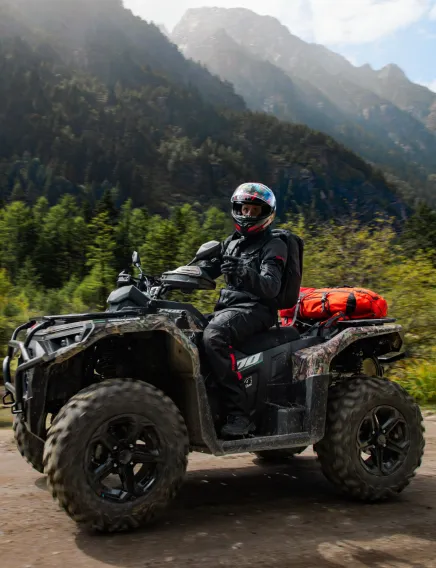
Loads should be strapped to the rack, not to the handlebars, where they affect steering. Water and clothing belong on the list even on short routes, because trail delays are unpredictable. A tool roll, a tow strap and a means of repairing a puncture should be permanent equipment. A machine loaded for a day trip behaves differently enough to deserve a short shakedown ride.
Base specification covers the mechanical essentials and leaves the rider to add protection. Electric power steering is the single option that most riders notice on the first long day. Winch-equipped specifications matter for anyone riding alone or in deep mud. The right comparison is total delivered cost, including transport, tax and the first service. The specification suffix changes the machine more than the model name does.
The qualities that matter most are predictable steering, usable low-speed torque and suspension that keeps the tyres loaded. Seen from the workshop, for best atvs for offroad riding, the decisive numbers are payload, drivetrain layout and how reliably the delivery schedule holds. Comfort over a long day matters more than any single figure on the specification sheet. The first modification most owners make is tyres, and the second is usually a winch.
Book a walkaround, bring a tape measure, and check the machine against your own trailer before any deposit changes hands.

Leave a Reply